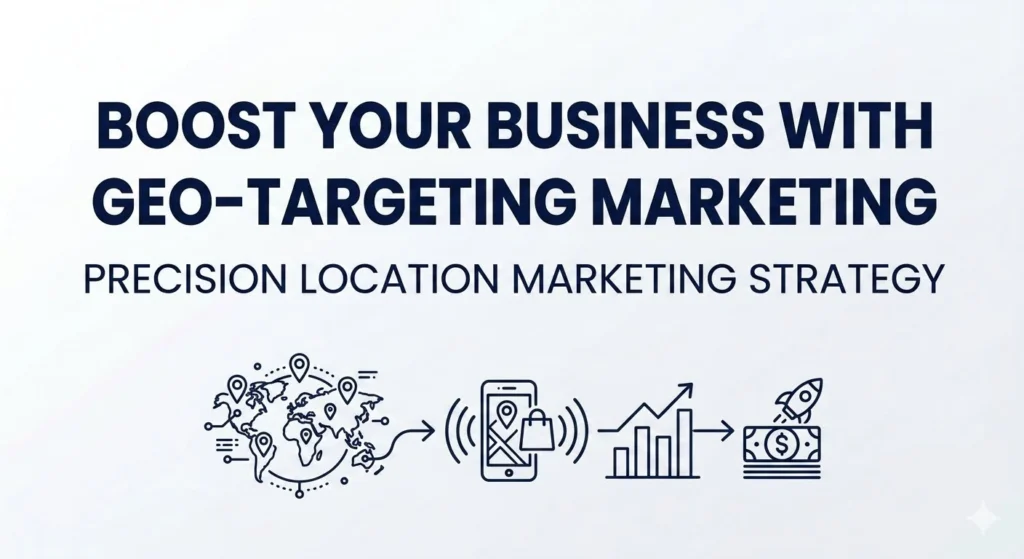
With the digital world being as competitive as it is these days, businesses need to reach out to their intended customers at the right location and at the right time – that’s where the concept of Geo Targeting Marketing comes into the picture. 46% of all Google searches are local, and of the 76% of people who search for local geo intent, 100% of them go to a business within 24 hours—no other marketing channel can match that ROI. You can deliver tailored ads, offers and content based on the exact geographic location of the user, potentially driving up to 35% more foot traffic and up to 20% more conversions than generic ads. It may go to making sure your messaging accurately reaches your target customer when they are most likely to be looking to purchase, from optimizing your Google Business Profile to managing hyperlocal mobile ads, or even by keeping your visibility in front of them in line with modern tactics such as Generative Engine Optimization, it will help you secure sustainable growth and future-proof your visibility..
Take your business to the next level with Geo Targeting Marketing
Location based strategies are a crucial element of digital success for businesses aiming to provide personalized experiences to their customers, ensuring they attract and keep them, all while fostering brand loyalty. Local search intent, audience behavior, and AI-generated content help brands deliver relevant information at the right time to consumers. Generative Engine Optimization assists businesses to gain greater visibility and achieve greater position-based marketing results in AI-powered search engines. Research indicates that 76% of people who find a local business by searching online visit it within a day and 28% of those searches result in a purchase, which is the advantage of implementing local business marketing. From a single city to multiple regions, adapting your content for a geographical context can benefit your website by generating more traffic, customer engagement, and conversions—all in the long term.
GEO and Its Authority
Generative Engine Optimization is emerging as a major game-changer in the digital search landscape where AI-generated answers are shaping online discovery. Now, more than 60% of Web queries return zero clicks as the result of the direct answer, provided by AI, which people can read on screen.Today, with more than 60 percent of Web queries returning zero clicks (because people can now read the direct answer provided by AI on screen), keyword ranking alone is not enough to guarantee visibility for brands. This pioneering benchmark study by Princeton and Georgia Tech shows the potential gains in AI-induced visibility gains from optimizing content for generative engines, such as using verified statistics, authoritative citations, and structured data, to the tune of up to 40%. Modern AI search models are more likely to favor authoritative sources that have established strong topic authority and earned brand mentions, and who have a clear context for their semantic information. Advancing toward establishing GEO authority calls for marketers to go past just counting backlinks to fostering entity relevance, empowering brands to obtain valuable citations and establish themselves for prime visibility in AI Overviews.
How Generative Engine Optimization Improves Content ROI for Enterprises
In the ever-evolving landscape of digital marketing, Generative Engine Optimization (GEO) is emerging as a transformative approach that enhances the ranking and conversion potential of AI-generated content. Generative Engine Optimization (GEO) is a game-changer in the world of digital marketing, boosting the rankings and conversions of AI-generated content. Search engines are increasingly considering the quality of the content they are providing and what they are trying to mine from the work and user goals, and GEO provisions a field guide to help creators optimize their models, meta, and content architecture for visibility and engagement. AI-backed pages can save time in creating content by up to 70%, and when strategically optimized, can boost the growth in organic traffic by 25-40%. GEO is also scalable: companies that use GEO-based workflows say they can scale up publish frequency by 30% without compromising publish quality. The use of voice search and multimodal search is growing and is projected to reach 50% of all searches by 2027; GEO enables AI to keep their results aligned with both search algorithms and users’ expectations. By understanding the benefits of GEO, you can make your SEO strategy more effective and helpful in reaching the future.
Generative Engine Optimization: The of Search Visibility
With the rise of AI-powered search engines, however, the way users discover information is changing, making Generative Engine Optimization (GEO) an essential tactic for brands seeking to be included in AI-generated responses. Unlike traditional SEO focusing on SERP rankings, it emphasizes on having content praised, summarized, or referenced by AI systems such as ChatGPT, Google AI Overviews, and other AI-powered platforms. AI Overviews feature in more than 60% of those Google searches, and 39% of users find information via AI chatbots compared to standard search engines. This change will make it crucial for brands to not miss out on their generative visibility if they are not paying attention to it. The advantage of optimizing for clarity, structured data, authoritative sources and natural language answers is that content becomes more likely to be incorporated into AI answers. The increasing penetration of AI-powered search into online activities, forecasted to affect more than 50% of search queries by 2027, means that early adopters will stay ahead of the curve in being found and trusted by potential customers.
The Future of Generative Engine Optimization
GEO is not the same as traditional SEO, where the primary goal was to rank on Google, Yahoo, and Bing; instead, GEO is more about optimizing content for AI-powered generative platforms that provide direct, conversational answers. Industry reports indicate that more than 65% of users are currently using AI-powered search tools and that the percentage could be as high as 80% by 2027. GEO recommends developing contextually and factually relevant content, with structure, which an artificial intelligence system is easy to understand and produce. Using statistics, titles, and short sentences are examples of factors that can help you get included in generative responses. SEO is projected to account for approximately 20% of digital advertising by the end of 2021, making it one of the fastest-growing ad formats.By 2030, the world’s total ad spend is believed to reach $1 trillion and companies that are ready to capitalize on GEO strategies will be better positioned for visibility and engagement.
Frequently Asked Questions (FAQs)
What is geo-targeting marketing?
Geo-targeting marketing is the digital strategy of delivering custom content or advertisements to users based on their specific geographic location. This location data is pulled from IP addresses, GPS signals, or cellular network data. Advertisers use it to match local demand with relevant promotional campaigns.
How does geotargeting differ from geofencing?
While both rely on location intelligence, their targeting criteria differ:
- Geofencing creates a virtual perimeter around a specific boundary. It reaches everyone who steps inside that area, regardless of their background.
- Geotargeting refines that location constraint by layering consumer demographics, user behaviors, and personal interests.
Can small businesses benefit from geo-targeting?
Yes, small businesses gain a massive competitive advantage by using hyperlocal targeting to maximize conversion rates on limited budgets. Instead of spending money on broad, national campaigns, local businesses can focus ad spend entirely on a specific mile radius, localized ZIP codes, or city neighborhoods.
Which advertising platforms support geo-targeting?
Most mainstream digital ad platforms offer robust location-based tools:
- Google Ads allows radius targeting and location exclusions.
- Meta (Facebook & Instagram Ads) targets specific markets and supports local engagement tracking.
- Snapchat & X (Twitter) Ads use real-time GPS and Wi-Fi data to track moving targets.
What are the best strategies to increase conversions using geotargeting?
Localized Ad Copy: Dynamically change headlines to name specific neighborhoods to increase trust.
Competitor Proximity: Target customers who are physically near a competing brand’s storefront.
Weather-Triggered Ads: Automate ad delivery based on local weather conditions, like pushing hot soup ads during sudden cold snaps.
Author Name: Hiten Neotia
Our Services: https://openinkhub.io/best-seo-services-in-india/